
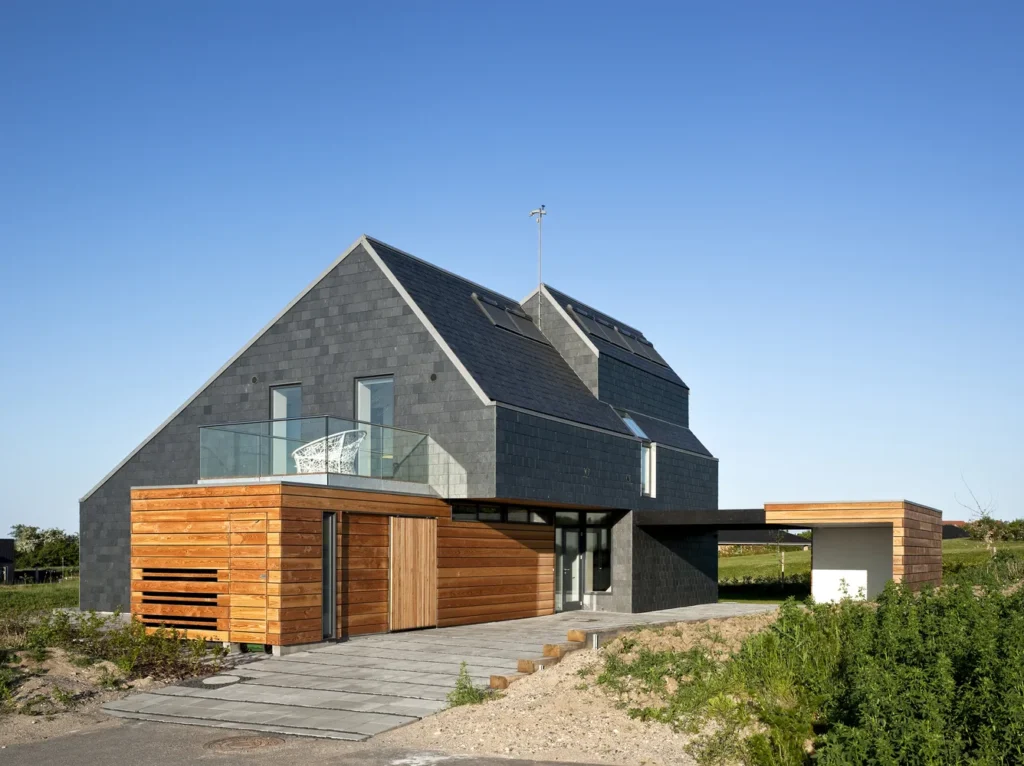
Few stones carry as much building memory as slate. It covered European roofs for centuries, became the classroom blackboard and the billiard table, and today it is back in the repertoire of architects and designers as a contemporary material: monochrome, matte, tactile and low in embodied energy.
For specifiers, slate offers something rare: a natural surface with a cleft texture and a sober palette that pairs as easily with exposed concrete and timber as with brass and linen. In this guide, we bring together its technical properties, some curiosities and the applications where the stone performs at its best, from floor to roof.
What is slate?
Slate is a very fine-grained metamorphic rock, formed from mudstones and siltstones subjected to moderate pressure and temperature over millions of years. In this process, the minerals (mainly mica, chlorite and quartz) realign along parallel planes, creating slaty cleavage: the rock splits into thin, regular slabs without losing strength.
In Brazil, production is concentrated in central Minas Gerais, especially around Papagaios. Discover other Brazilian natural stones and their uses.
Technical properties that matter to specifiers
Slate combines low porosity, good mechanical strength in thin pieces and thermal comfort to the touch. What counts when specifying:
- Low water absorption. Its compact structure reduces staining and suits wet and outdoor areas, always with a suitable sealer.
- Naturally slip-resistant surface. The natural cleft finish keeps its grip, useful around pools, on terraces and on stairs.
- Thermal inertia and comfort. It absorbs heat gradually, making it pleasant underfoot in shaded areas.
- Durability. Slate roofs can last around 100 years, with occasional replacement of individual pieces.
- Low embodied energy. Processing is essentially cutting and finishing, with no firing or chemical processes.
- Point of attention. Slate is softer than granite and quartzite. On heavily used countertops, scratches and acid marks (lemon, vinegar) call for sealing and maintenance.
Colours and finishes
The Brazilian slate palette opens distinct paths for a project:
Grey
The most widely produced in Brazil. Neutral and versatile, it works on floors, façades, countertops and roofs.
Black (graphite)
Dramatic and contemporary; it sets off metals and light woods on countertops, powder rooms, panels and furniture.
Green
An organic tone that blends with landscaping. Suited to outdoor areas, pools and gardens.
Rust (multicolour)
Oxidised veins bring warmth and rusticity to feature walls, fireplaces and country houses.
Purple
The rarest, in a greyish wine tone. Ideal for signature pieces and accent cladding.
The most common finishes:
For standards, refer to the ABNT NBR 15845 tests (stone for cladding) and, for roofing aimed at export, the European standard EN 12326.
Where to use it
Slate adapts to many uses, and the right finish makes all the difference to performance.
01 Interior floors
Thermal comfort, a continuous look and a good response to residential traffic, in a honed or brushed finish.


02 Outdoor floors and pool surrounds
The natural cleft or bush-hammered version provides a slip-resistant surface and a pleasant temperature underfoot.
03 Façades and ventilated façades
Lightweight panels and durability come together with a texture that changes with daylight, in natural or brushed finishes.
04 Feature walls and fireplaces
They gain chromatic depth and relief with natural pieces or strip mosaics.

05 Bathrooms and powder rooms
Low absorption and a monochrome look call for a honed finish with sealer.

06 Countertops and furniture
Tabletops, sideboards and carved basins work best polished or honed, always sealed.
07 Roofs
The most traditional application and one of the most durable. It requires a steep pitch, stainless-steel or copper fixings, a structure sized for the weight, and a laying pattern that becomes the project's signature: rectangular, fish-scale or diamond.
Specification tip
Approve samples from the batch, use mortar for natural stone, respect the joints, seal, and clean only with neutral products.
Over time, slate gains patina and depth of colour. That is a feature, not wear.
Frequently asked questions
Is slate good for outdoor flooring?
Yes. With a natural cleft or bush-hammered finish, slate keeps a slip-resistant surface and a pleasant temperature underfoot, making it a good fit for terraces, stairs and pool surrounds. Its low water absorption also favours outdoor use, always with a suitable sealer.
How do you seal slate?
Apply a sealer designed for natural stone after installation, on clean, dry stone. For maintenance, use only neutral cleaning products. On countertops and in bathrooms, sealing is essential to protect against acid marks from lemon or vinegar.
Can slate be used on ventilated façades?
Yes. The lightness of the panels and the durability of the stone suit façades and ventilated façades, in natural or brushed finishes, with a texture that changes with the light throughout the day.
What colours does slate come in?
Brazilian slate is available in grey (the most widely produced), black or graphite, green, rust (multicolour) and purple, the rarest of them.